Latest News & Announcements

Date Announcement
2026/07/28 The Call for Late-Breaking Results (LBR) has been released.
2026/07/28 The Call for Special Session and Innovative Practices Session Proposals has been released.
2026/06/28 The submission deadline has been postponed to July 7, 2026. It is the final extension. Please submit your papers before the deadline.
2026/06/12 The submission deadline has been postponed to June 30, 2026.
2026/05/30 The submission deadline has been postponed to June 16, 2026.
2026/02/25 The Call for Papers has been released.
2025/12/10 Website up!
 

Important Dates


Important Dates
  • Submission deadline: June 6, 2026
    July 7, 2026
  • Notification of acceptance: Sept. 14, 2026
  • Camera ready manuscript: Oct. 13, 2026


Conference Overview

The IEEE 35th Asian Test Symposium (ATS 2026), a premier international forum in the field of electronics testing, will be held at the Hotel Nikko Kaohsiung in Taiwan from December 1 to 3, 2026. This conference serves as a pivotal platform for academic researchers and industry professionals from around the globe. Its primary objective is to facilitate the exchange of groundbreaking ideas and the presentation of the latest research findings. We cordially invite the submission of original papers covering all aspects of system, module, and device testing, as well as broader test technologies.

Global Network

Connect with researchers and professionals worldwide

Innovation Exchange

Share groundbreaking ideas and latest research

Paper Submissions

Submit original papers on testing technologies

Call for Late Breaking Results (LBR)

New Track

For the first time, the Asian Test Symposium (ATS) 2026 is pleased to introduce the Late-Breaking Results (LBR) Track—a timely and high-visibility forum for showcasing emerging research, recent breakthroughs, and impactful project outcomes to the test, reliability, and dependable systems community.

The LBR Track offers researchers a unique opportunity to rapidly disseminate and receive valuable feedback on ongoing work, newly obtained results, innovative concepts, and fresh insights of strong relevance to the ATS community. We particularly welcome submissions that present promising directions, timely findings, and novel ideas with the potential to stimulate discussion and shape future research.

Submission Guidelines

Submissions must be prepared as extended abstracts using the standard IEEE two-column format and may be up to three pages in length, including references. All submissions must address new research relevant to the technical scope of ATS.

Examples of suitable LBR contributions include, but are not limited to:

  • Breakthrough approaches that address known problems from novel research perspectives; and
  • Promising new results supported by sufficient evidence to demonstrate the viability of the proposed work.

LBR submissions must present original and innovative work. All submissions will be peer-reviewed by the ATS 2026 Technical Program Committee. Accepted LBR papers will be included in the ATS 2026 proceedings.

Submission Procedure

LBR submissions must be submitted through the ATS 2026 EasyChair submission system:


The same EasyChair submission system is used for Regular Papers, Late-Breaking Results, and Special & Innovative Session Proposals. After entering the submission system:

  1. Click New Submission.
  2. On the Select a Track page, select:
    ATS 2026 Late-Breaking Results (LBR) EasyChair track selection showing ATS 2026 Late-Breaking Results (LBR)
  3. Click Continue.
  4. Complete the submission form and upload the manuscript in PDF format.

Authors must ensure that the Late-Breaking Results (LBR) Track is selected. Submissions entered under the Regular Paper or Special & Innovative Session Proposal Track will not be treated as LBR submissions.

Submissions by email will not be accepted.

Call for Special Session and Innovative Practices Session Proposals

The Asian Test Symposium (ATS) 2026 invites proposals for Special Sessions and Innovative Practices Sessions that address timely, emerging, and high-impact topics of interest to the test, reliability, and dependable systems community.

These sessions are intended to complement the regular technical program by providing focused forums for presenting recent advances, exchanging perspectives, discussing emerging challenges, and promoting interaction among researchers and industry practitioners.

SPECIAL SESSION PROPOSALS

Special Sessions should focus on timely, emerging, or rapidly developing topics of broad interest to the ATS community. Proposed sessions may include invited technical presentations, panel discussions, embedded tutorials, or a combination of these formats.

Special Sessions are particularly encouraged when they:

  • address an important or emerging research direction;
  • bring together complementary perspectives from academia and industry;
  • provide a focused discussion of recent advances, challenges, and future opportunities; or
  • introduce topics that may stimulate new research activities and collaborations within the ATS community.

Each proposal must include:

  • a 150–200-word session abstract;
  • the names, professional titles, affiliations, and contact information of the session organizer(s);
  • the name of the proposed session moderator, if different from the organizer(s);
  • a list of at least three prospective speakers;
  • the affiliation, contact information, and tentative presentation title of each speaker;
  • a brief description of the proposed session structure and expected contributions; and
  • a tentative schedule indicating the time allocated to each presentation, discussion, and interactive activity.

If a Special Session proposal is accepted, the organizers and speakers will be invited to prepare one of the following for inclusion in the formal conference proceedings:

  1. One consolidated paper, authored by all or a subset of the presenters, of up to 10 pages, excluding references; or
  2. Three individual papers, each of up to 4 pages, excluding references.

All submitted papers must comply with the ATS 2026 formatting, review, registration, and publication requirements.


INNOVATIVE PRACTICES SESSION PROPOSALS

Innovative Practices Sessions highlight cutting-edge challenges encountered by industry practitioners and showcase innovative, practical, and impactful solutions developed to address them.

These sessions are intended to promote knowledge exchange between industry and academia by presenting real-world experiences, emerging industrial needs, successful practices, lessons learned, and new opportunities in test, reliability, and dependable systems.

Innovative Practices Session proposals are particularly encouraged when they:

  • present an important industrial challenge or emerging practical need;
  • describe an innovative methodology, technology, workflow, or solution;
  • provide lessons learned from real-world deployment or implementation;
  • identify gaps between academic research and industrial practice; or
  • stimulate discussion and future collaboration between researchers and practitioners.

Each proposal must include:

  • a 150–200-word session abstract;
  • the names, professional titles, affiliations, and contact information of the session organizer(s);
  • the name of the proposed session moderator, if different from the organizer(s);
  • a list of at least three prospective speakers;
  • the affiliation and tentative presentation title of each speaker;
  • a brief description of the industrial challenges, practical solutions, or experiences to be presented; and
  • a tentative schedule indicating the time allocated to each presentation, discussion, and interactive activity.

If an Innovative Practices Session proposal is accepted, the organizers and speakers will be invited to prepare a one-page session abstract describing the scope, key topics, and expected contributions of the session.

SUBMISSION GUIDELINES

Each proposal must be no more than two A4 pages and should clearly include the following information:

  • the title, scope, and main topic or topics of the proposed session;
  • a 150–200-word abstract summarizing the session;
  • the objectives of the session and its relevance to ATS 2026;
  • an explanation of why the proposed session is expected to attract broad interest from the ATS community;
  • its alignment with timely, emerging, or high-impact topics in test, reliability, and dependable systems;
  • the planned session structure, such as technical presentations, a panel discussion, an embedded tutorial, industry case studies, or other interactive activities;
  • the proposed session duration and detailed schedule;
  • the names, affiliations, contact information, and tentative presentation titles of the prospective speakers;
  • a brief, two-sentence biography of each speaker and moderator;
  • a brief biography of each organizer describing relevant experience in organizing special sessions, panels, tutorials, workshops, or related activities at international conferences or professional events; and
  • the names, professional titles, affiliations, and contact information of the session organizer(s) and, if different, the session moderator.

The session moderator may also serve as one of the invited speakers.


SUBMISSION PROCEDURE

Special Session and Innovative Practices Session proposals must be submitted through the ATS 2026 EasyChair submission system:


After entering the submission system:

  1. Click New Submission.
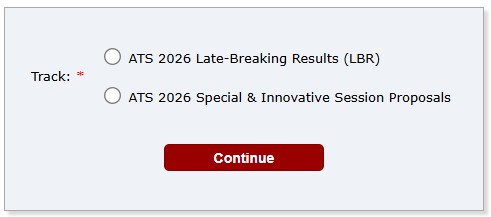
  2. On the Select a Track page, select:
    ATS 2026 Special & Innovative Session Proposals EasyChair track selection showing the ATS 2026 Late-Breaking Results and Special & Innovative Session Proposals tracks
  3. Click Continue.
  4. Complete the submission form and upload the proposal document.

In EasyChair, both proposal types use the EasyChair track labeled ATS 2026 Special & Innovative Session Proposals. Please ensure that this track is selected. Submissions entered under the Late-Breaking Results (LBR) Track will not be treated as Special Session or Innovative Practices Session proposals.

Submissions by email will not be accepted.

SESSION DURATION AND FORMAT

Each proposed session should be between 60 and 90 minutes in duration.

Each technical presentation should be approximately 20–30 minutes, depending on the number of speakers and whether the session includes presentations, a panel discussion, an embedded tutorial, or other interactive activities.

The proposal should clearly indicate the time allocated for presentations, discussion, audience interaction, and, where applicable, panel or tutorial activities.

Organizers are encouraged to reserve sufficient time for questions, discussion, and interaction with the audience.

PARTICIPATION REQUIREMENT

By submitting a proposal, the organizers, moderators, and prospective speakers confirm their intention to register for and participate in ATS 2026 if the proposed session is accepted.

At least one organizer must be responsible for coordinating the session, communicating with the ATS 2026 Organizing Committee, and ensuring the timely submission of all required publication materials.

Call for Papers

The ATS 2026 Organizing Committee invites original, unpublished paper submissions on the topics listed below. Regular paper submissions should be made electronically by PDF manuscripts only, not exceeding 6 pages in IEEE 2-column format (including abstract, figures, tables, and bibliography). A submission will be considered evidence that upon acceptance, at least one author will attend the conference to make the presentation. Authors of accepted papers are responsible for preparing the final manuscripts in time to be included in the electronic proceedings. Accepted papers will be submitted for inclusion into IEEE Xplore subject to meeting IEEE Xplore's scope and quality requirements. At least one author registration (full rate) to the conference is required for each accepted paper. More information is available from the following link: Submission Guidelines.

Requirements
  • 6 pages maximum
  • IEEE 2-column format
  • PDF format only
  • Original work
  • Author attendance
  • Full registration

Topics — Original papers on, but not limited to, the following areas are invited:

  • AI test and Test for AI
  • Analog/Mixed-Signal Test
  • ATE Design
  • Automatic Test Pattern Generation (ATPG)
  • Autonomous Testing
  • Board-Level Testing and Diagnosis
  • Boundary Scan Test
  • Built-In Self-Test (BIST)
  • CPU/GPU Test
  • Connectivity Testing
  • Defect-Based Test
  • Delay and Performance Test
  • Dependability and Functional Safety
  • Design Verification, Validation, and Debug
  • Design for Testability (DFT)
  • Diagnosis and Silicon Debug
  • Fault Diagnosis and Failure Analysis
  • Fault Modeling and Simulation
  • Fault Tolerance
  • Hardware Oriented Security and Trust
  • High-Speed I/O Test
  • Heterogeneous Testing
  • Low-Power IC Test
  • Machine Learning in Test
  • Memory Test, Diagnosis, and Repair
  • Multi-/Many-core Processor Test
  • Online Test
  • On-Chip Measurement
  • Power/Thermal/Reliability Issues in Test
  • Reconfigurable System Test
  • Reliability and Testing for Emerging/Approximate/Quantum Computing
  • RF Test
  • Safety and Test for Automotive ICs
  • Self-Repair
  • SiP, Chiplet, 2.5D and 3D IC Test
  • Software Test and Reliability
  • Standards in Test
  • System-on-Chip Test
  • Test Compression
  • Test Economics
  • Test Quality
  • Test Synthesis
  • Test for Biomedical Circuits and Systems
  • Test for MEMS and Microfluidic Systems
  • Test for Nanoscale Devices and Emerging Technologies
  • Test for Reversible and Quantum Circuits
  • Test for Sensors and IoT
  • Yield Analysis, Learning, and Enhancement

Conference Organizers

Our Sponsors